
Music School Audition Timeline

Quick Answer
Quick Answer: A music school audition timeline should begin at least 9 to 12 months before auditions. Use that time to choose smart repertoire, build a balanced school list, plan prescreen recordings early, and run repeated mock auditions. The goal is simple. No last-minute scrambling.
Why a Music School Audition Timeline Matters
Music admissions are layered. Most programs evaluate applicants through academic review, prescreens, and live auditions. Studio capacity also shapes final outcomes.
If repertoire is selected too late, recordings suffer. If prescreens are rushed, live auditions never happen. If the school list is unbalanced, options shrink. A structured timeline prevents reactive decision-making.
12 Months Before Auditions
Repertoire Strategy
Confirm repertoire requirements for likely target schools. Choose pieces that show strengths, not just difficulty. Map technical gaps honestly.
Teacher and Coach Alignment
Meet with your private teacher to outline the year. Decide what needs to improve first and what can wait.
Technical Development Benchmarks
Set measurable targets for tone, intonation, rhythm, diction, articulation, phrasing, and stylistic control depending on instrument or voice.
Early School Research
Identify programs by studio and faculty fit, program focus and culture, geography and logistics, and total cost range. Fit first beats prestige first.
9 Months Before Auditions
Refine the School List
Build a balanced list: Reach, Match, Realistic. If the list is still unclear, review Music School List Strategy.
Confirm Prescreen Requirements
Document required repertoire, recording format, submission platform, and deadlines for each school.
Begin Mock Performance Cycles
Perform repertoire regularly in studio class, recitals, or informal settings. Confidence grows through repetition.
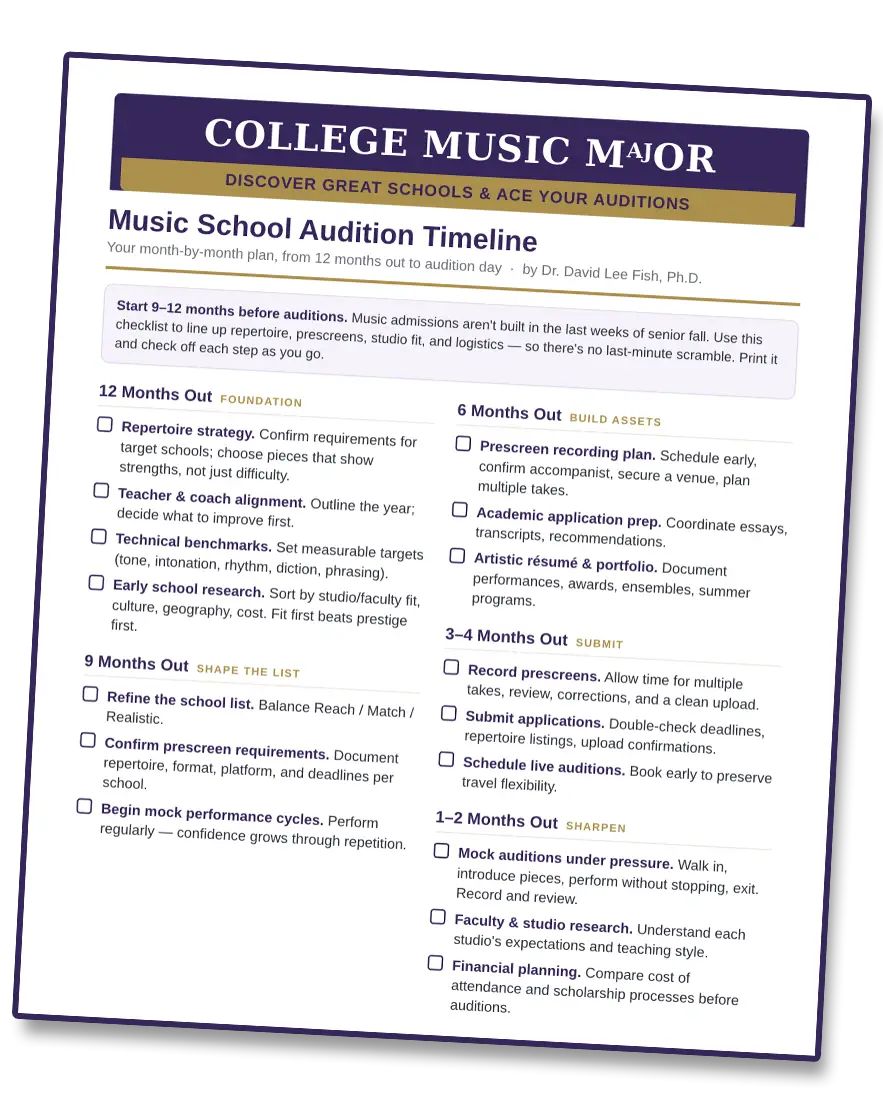
Get this timeline as a printable month-by-month PDF
Stick it on the fridge. Tape it on the wall. The full 12-month plan — repertoire, recordings, prescreens, deadlines, and auditions — laid out so nothing sneaks up on you.
What Is the Real Acceptance Rate for Music Schools?
The real answer depends on the studio or program of study.
Conservatories typically rank primarily on artistic strength. University-based music schools require both audition success and academic clearance. Some programs conduct academic pre-screens before final artistic approval.
Many accredited programs follow standards established by the National Association of Schools of Music. Accreditation ensures curriculum quality. It does not regulate studio capacity.
- How many seniors graduate from that studio
- Whether a teacher is accepting new students
- The strength of that year’s applicant pool
- Your artistic ranking
- Institutional enrollment strategy
Students building a balanced strategy should review our music admissions services overview.
How Acceptance Rates Compare Across Top Schools
| School | What Drives Competitiveness |
|---|---|
| Frost School of Music acceptance rate | University academics plus audition strength |
| Eastman music admission rate | Conservatory-style artistic ranking |
| Manhattan School of Music acceptance rate | Studio-dependent selectivity |
| USC Thornton audition competitiveness | Highly competitive contemporary tracks |
Comparisons provide context. They do not determine your odds. What matters most is studio capacity and your ranking within that specific audition pool.
For broader planning, see our Majoring in Music Admissions Guide.
Conservatory vs University: Structure Shapes Selectivity
| Program Type | Primary Filter | Secondary Filter |
|---|---|---|
| Conservatory | Artistic ranking | Minimal academics |
| University Music School | Audition | Academic threshold |
| Dual Degree | Separate admissions | Both must approve |
The Bottom Line
Music school acceptance rates provide context. They do not provide certainty. Admission depends on studio capacity, faculty decisions, and your ranking within that audition pool.
College Music Major provides structured guidance built around studio research, audition evaluation, and strategic list design, and Dr. Fish's expertise in the world of music higher education. Explore our music admissions services to develop a clear, balanced plan.