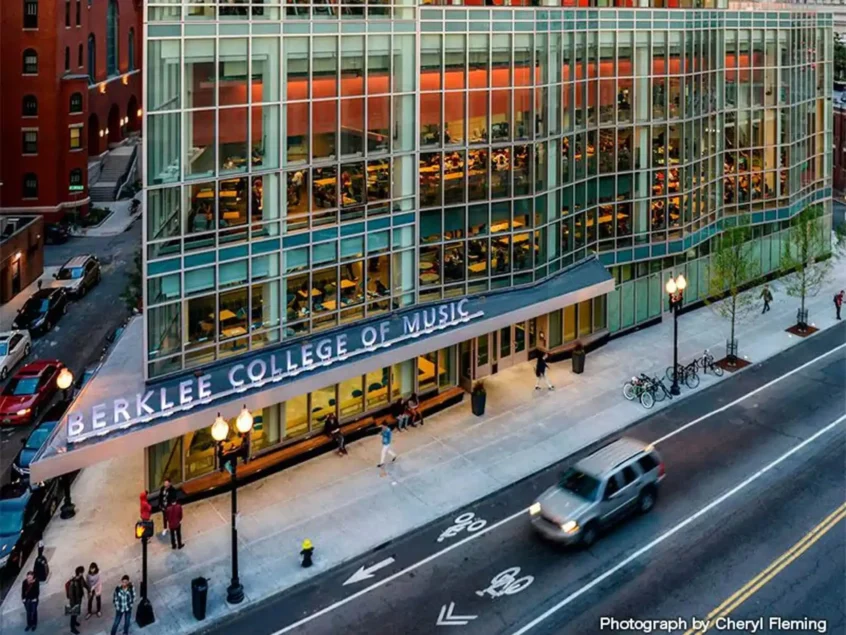
(Last updated: Ferburary 2026) The Berklee Acceptance Rate is typically estimated at 50-55% in recent admissions cycles. That percentage provides context, not certainty. The Berklee College of Music Acceptance Rate reflects a large contemporary music institution that evaluates creativity and musicianship differently from traditional conservatories.
Berklee Acceptance Rate: Key Stats
| Metric | Value |
|---|---|
| Estimated acceptance rate | 50–55% |
| Institution type | Independent contemporary music college |
| Admissions focus | Audition, musicianship, creativity |
| Most competitive areas | Production, songwriting, performance |
| Academic role | Required but secondary to musical readiness |
| Admission model | Broad intake model |
Berklee Acceptance Rate Explained
The Berklee number appears higher than many classical conservatories. That does not mean standards are lower.
Berklee operates at scale. It spans performance, production, songwriting, film scoring, and the music business. A larger intake changes the percentage, not the expectations.
Admission still depends on how convincingly you demonstrate musicianship, stylistic fluency, and artistic direction.
Why the Berklee College of Music Acceptance Rate Can Be Misunderstood
Some families assume a higher rate equals easier admission. That assumption misses how Berklee evaluates talent.
Berklee looks for:
• Musical fluency
• Stylistic authenticity
• Creative originality
• Ensemble readiness
It is not ranking instrumentalists inside tiny studio cohorts. It is assessing readiness for a contemporary music ecosystem.
How Berklee Compares to Other Music Schools
| School | Estimated Acceptance Rate* |
|---|---|
| Berklee College of Music | 50–55% |
| The Juilliard School | About 7–10% |
| Eastman School of Music | 20–30% |
| Frost School of Music | 20–30% |
| Curtis Institute of Music | About 4–5% |
Rates vary by program and admission year.
This rate reflects scale. Berklee is large. That scale affects the math, not the seriousness of competition.
Find your perfect fit!
NEW! School Music Finder
Most college search tools treat music like any other major. College Music Major’s Music School Finder filters 253 curated programs recognized for excellence by instrument, genre, and audition competitiveness — the factors that actually determine fit. Browse now and build a smarter list.

What Determines Your Outcome Beyond the Berklee Acceptance Rate
Musical Fluency
Berklee evaluates groove, harmonic awareness, rhythmic command, and stylistic control. Practical musicianship matters.
Creative Identity
Original voice separates admitted students from technically competent but interchangeable applicants.
Portfolio and Audition Strength
Your submission must show control and intention. Production applicants are judged on sonic clarity and originality.
Academic Readiness
Academic standards apply, but musical readiness drives decisions once baseline requirements are met.
Is the Berklee Acceptance Rate Realistic for You?
If you are actively writing, performing, producing, and collaborating, Berklee is realistic.
If your training is exclusively classical and you lack contemporary fluency, preparation is essential.
If your GPA is strong but your musicianship is inconsistent, understand this clearly: academic strength does not substitute for creative command.
Preparation determines positioning.
Updated 2026 Edition!
Music School Admissions:
Ultimate DIY GUIDE
Turn Your Audition into an Acceptance Letter! Stop guessing what admissions officers want to hear. Get the blueprint used by successful applicants to top conservatories and universities.

FAQ
What is the Berklee Acceptance Rate?
The Berklee Acceptance Rate is generally estimated between 50 and 55 percent, depending on program and admission year.
Is Berklee less selective than Juilliard?
The Juilliard School is more selective numerically. Berklee operates under a different admissions model.
Does GPA affect admission?
Applicants must meet academic standards, but audition and creative readiness carry greater weight.
Are some programs more competitive?
Yes. Production, songwriting, and contemporary performance often attract large applicant pools.
Can a strong audition outweigh weaker academics?
Within reasonable limits, yes. Musical fluency and creative strength are typically decisive.
Bottom Line
The above rate provides perspective. Your musicianship provides leverage.
If you demonstrate stylistic fluency and creative clarity, admission becomes realistic. If you rely only on the percentage, you misunderstand how Berklee evaluates talent.
The distinction matters.

Dr. David Lee Fish, Ph.D.
The founder of College Music Major. Doctor Fish is a veteran figure in music and education, with an extensive career spanning decades of dedication and hard work. He is known for his unique approach to music and his commitment to sharing his passion with others. His expertise spans performance, education, and private consulting, making him a renaissance man in the music education sector.