
About Music School Acceptance Rates (2026 Guide)

Quick Answer
Music school acceptance rates typically range from 5 to 35 percent, but those published numbers rarely reflect true studio-level selectivity. But that number rarely reflects studio-level selectivity. Admission decisions are driven by faculty capacity and audition ranking within your instrument. Your real odds depend on where you rank inside that specific studio pool.
You are not competing against the entire applicant universe. You are competing for a seat in a particular studio.
What Are Music School Acceptance Rates?
Music school acceptance rates describe the percentage of applicants admitted in a given year. Most institutions report overall university admission data rather than instrument-specific or studio-specific numbers.
Institutional data is often reported through the NCES IPEDS database, which provides institution-wide statistics. It does not break down individual music studios.
Acceptance patterns reflect recent reporting cycles and current studio capacity trends. They are not fixed quotas.
Why Acceptance Rates Feel So Confusing
Applicants audition. Faculty rank students artistically. Studio capacity determines how many offers go out. Waitlists are created. Yield projections influence final numbers.
If a professor has three openings and 30 strong applicants, the effective rate for that studio is 10%. Another instrument in the same school may have very different math.
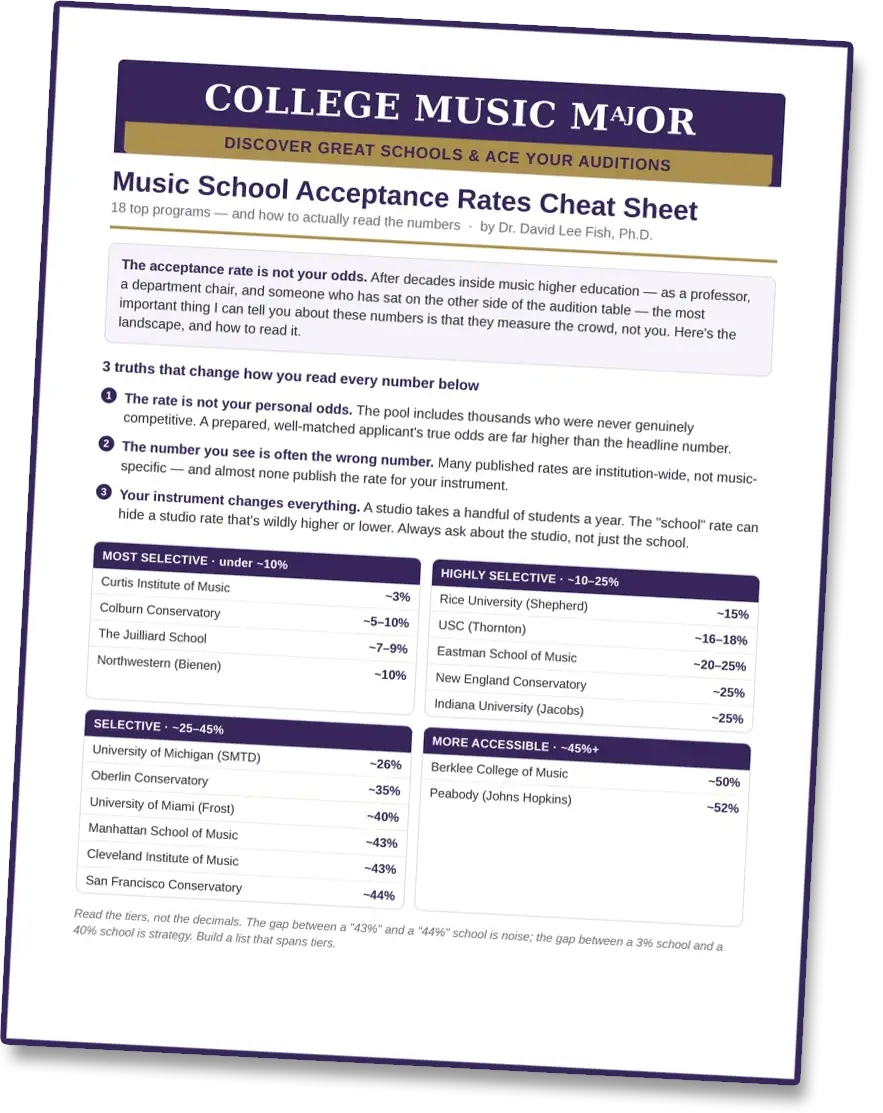
Get the Music School Acceptance Rates Cheat Sheet
The acceptance rate is not your odds — but you still need to know the landscape. Get all 18 top programs ranked by selectivity on one page, plus the 3 things the numbers don't tell you.
What Is the Real Acceptance Rate for Music Schools?
The real answer depends on the studio or program of study.
Conservatories typically rank primarily on artistic strength. University-based music schools require both audition success and academic clearance. Some programs conduct academic pre-screens before final artistic approval.
Many accredited programs follow standards established by the National Association of Schools of Music. Accreditation ensures curriculum quality. It does not regulate studio capacity.
- How many seniors graduate from that studio
- Whether a teacher is accepting new students
- The strength of that year’s applicant pool
- Your artistic ranking
- Institutional enrollment strategy
Students building a balanced strategy should review our music admissions services overview.
How Acceptance Rates Compare Across Top Schools
| School | What Drives Competitiveness |
|---|---|
| Frost School of Music acceptance rate | University academics plus audition strength |
| Eastman music admission rate | Conservatory-style artistic ranking |
| Manhattan School of Music acceptance rate | Studio-dependent selectivity |
| USC Thornton audition competitiveness | Highly competitive contemporary tracks |
Comparisons provide context. They do not determine your odds. What matters most is studio capacity and your ranking within that specific audition pool.
For broader planning, see our Majoring in Music Admissions Guide.
Conservatory vs University: Structure Shapes Selectivity
| Program Type | Primary Filter | Secondary Filter |
|---|---|---|
| Conservatory | Artistic ranking | Minimal academics |
| University Music School | Audition | Academic threshold |
| Dual Degree | Separate admissions | Both must approve |
The Bottom Line
Music school acceptance rates provide context. They do not provide certainty. Admission depends on studio capacity, faculty decisions, and your ranking within that audition pool.
College Music Major provides structured guidance built around studio research, audition evaluation, and strategic list design, and Dr. Fish's expertise in the world of music higher education. Explore our music admissions services to develop a clear, balanced plan.