Last updated: March 2026
Quick Answser
As an independent educational consultant specializing in working with college-bound musicians, I'm often asked why band matters more in high school than in college.
Concert band and marching band often sit at the center of a high school instrumentalist’s musical life because they combine training, belonging, performance, visibility, and school identity in one experience. In college, most music majors move into more specialized, degree-driven work, so band usually becomes less central except for music education majors, whose future careers still depend heavily on band literature, pedagogy, and ensemble leadership.
For many high school students, band is where music becomes real. It is where they rehearse every day, perform in public, travel with friends, represent their school, and begin to think of themselves as musicians. That role is powerful, and it deserves respect. But college music study is usually organized around different goals. Instead of building broad musical and personal development through one large ensemble culture, colleges tend to focus students more narrowly on the specific demands of their degree path. That shift can be surprising to families, especially when a student’s identity has been deeply tied to concert band or marching band in high school.
Why band matters in high school more than college
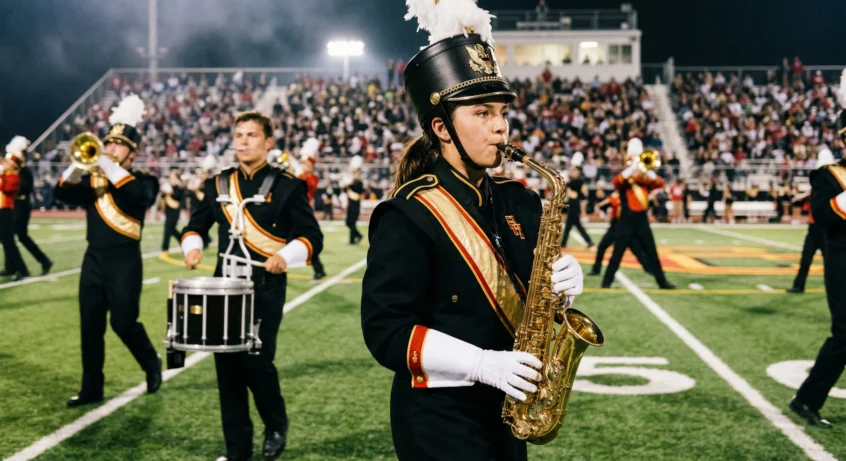
In most high schools, band is much more than a performance outlet. It is often the main structure through which instrumental students grow. Concert band teaches reading, tone, listening, blend, balance, intonation, phrasing, and ensemble discipline. Marching band adds movement, endurance, memorization, coordination, and public performance under pressure. Together, they create a strong foundation for young players.
Just as important, band gives students a place to belong. Many teenagers find their closest friends, strongest mentors, and clearest sense of purpose through band. They are not only learning notes and rhythms. They are learning how to show up, how to work with a section, how to lead, and how to contribute to something larger than themselves.
Band is also unusually visible. Marching band appears at football games, parades, competitions, and civic events. Concert band often performs at concerts, festivals, and school ceremonies. In many communities, band students become some of the most public representatives of the arts in the school. That public role helps shape musical identity. For many students, being “in band” is not just one activity among many. It is a defining part of who they are.
What does high school band give students beyond musicianship?
High school band often provides several layers of growth at once.
- Musical skill through regular rehearsal and performance
- Community through friendships, section culture, and shared goals
- Leadership through roles like section leader, drum major, or peer mentor
- Structure through routines, expectations, and accountability
- Identity through school representation and public performance
That combination is part of what makes band so central in high school. It is not merely an ensemble. It is often the core environment in which students experience music, discipline, teamwork, and recognition all together.
Why does the role of band often change in college?
The basic reason is simple. College music programs are usually not designed to replicate high school band culture. They are designed to prepare students for specific professional and academic paths.
A college music major may still perform in wind ensemble, symphonic band, or marching band. But for many students, those groups no longer occupy the center of musical life in the same way. The center shifts toward private lessons, studio expectations, juries, recitals, chamber music, repertoire preparation, academic coursework, and major-specific ensemble work.
That does not mean band stops mattering. It means band is no longer asked to do everything at once.
In high school, band may be the heart of a student’s musical, social, and school identity. In college, those functions are often distributed across many parts of the program. Students may find artistic identity in the studio. They may find belonging among peers in their major. They may find their main performance growth in chamber groups, jazz combos, opera workshop, conducting lab, composition readings, or solo study.
Find your perfect fit!
NEW! School Music Finder
Most college search tools treat music like any other major. College Music Major's Music School Finder filters 264 curated programs recognized for excellence by instrument, genre, and audition competitiveness — the factors that actually determine fit. Browse now and build a smarter list.
How does this shift look for different college music majors?
The answer depends heavily on the degree.
A performance major may still play in concert band, but private study, juries, recitals, excerpts, and auditions often carry more weight. A jazz major may spend far more time in jazz ensemble, combo, improvisation, transcription, and applied lessons than in wind band. A composition major may focus on writing, orchestration, theory, analysis, and hearing original work performed. A music industry or production student may have little reason for band to remain central at all.
This is where families sometimes get caught off guard. A student who lived for marching season in high school may arrive at college and discover that the most serious students in the program are investing their energy elsewhere. That is not because they do not value band. It is because their degrees ask different things of them.
A point families should understand about college marching band
This part is worth handling carefully because students often arrive with strong feelings about marching band.
At many universities, music majors beyond music education do not participate in marching band at all, or they participate in much smaller numbers than families expect. Many college marching bands are made up largely of non music majors, along with some music students who join for community, school spirit, scholarship support, or enjoyment. In other words, college marching band is often not the professional center of musical training for most music majors in the way high school marching band may have been.
That is not a criticism of marching band. It is simply a different reality.
It is also true that some private applied instructors are opposed, or at least resistant, to their students taking part in marching band. Their concern is usually practical rather than ideological. They may feel that the long rehearsal hours, game-day demands, travel, physical fatigue, and time commitment are not the best use of a serious music student’s limited energy. From their point of view, that time may be better spent on practicing, repertoire, lessons, chamber music, auditions, juries, or degree-specific performance work.
This does not mean every teacher feels that way, and it does not mean marching band has no value in college. It means students should understand that in some college music cultures, marching band is seen more as an optional campus activity than as a central component of advanced musical training.
High school band vs college music study
| Area | High School Concert and Marching Band | College Music Major Experience |
|---|---|---|
| Primary role | Broad musical growth, school identity, community involvement | Specialized training tied to degree goals |
| Student identity | Often the center of musical life | Often one part of a more focused training path |
| Main performance setting | Usually a primary ensemble home | One among several possible ensemble or studio experiences |
| Marching band status | Often central and highly visible | Often optional, less central, or populated heavily by non majors |
| Time use | Supports broad student development | Competes with lessons, practice, juries, recitals, and major coursework |
| Faculty perspective | Widely embraced as core student activity | Sometimes viewed as secondary for non music education majors |
| Strongest exception | Important for most band students | Remains especially relevant for music education majors |

Why are music education majors the major exception?
Music education majors are the clearest exception because school band remains directly connected to what they are preparing to do professionally. A future band director needs more than personal playing ability. That student needs to understand rehearsal strategy, score study, conducting, ensemble balance, instrumentation, sequencing, literature selection, classroom management, and the day to day realities of directing young players.
For that reason, concert band and sometimes marching band continue to matter in a more direct way for music education students than they do for many other majors. These students are not simply participating as performers. They are also absorbing models of rehearsal technique, ensemble organization, and repertoire that may shape their future teaching.
A music education student may watch a college conductor and think like a future teacher. A performance major may watch the same rehearsal and think mainly about individual playing. That difference matters.
Why does this change sometimes feel difficult for students?
Students who were deeply invested in high school band often experience an identity shift when they get to college. In high school, band may have been the place where they felt most known and most successful. In college, they enter a setting full of other serious musicians, and the structure of daily life changes. The ensemble that once defined them may no longer be the center of their training.
That can feel disorienting, especially at first.
It helps when students understand ahead of time that this is a normal transition rather than a loss. College is not supposed to erase what band meant in high school. It is supposed to build on that experience and move the student toward more focused artistic and professional goals.
What should students and parents take from this?
First, high school band deserves to be honored for what it gives young musicians. Concert band and marching band build skills, confidence, discipline, friendships, and a sense of purpose. For many students, they are the reason music becomes a serious part of life in the first place.
Second, families should not assume that college music study is simply a more advanced version of high school band. For many majors, it is not. The center of gravity shifts.
Third, students should pay close attention to how ensemble life actually functions at the colleges they are considering. They should ask:
- Which ensembles are required for this major?
- Do most music majors participate in marching band, or mostly non-majors?
- How do private teachers view marching band participation?
- What kinds of ensemble work matter most for this degree path?
- How much time is expected for lessons, practice, juries, and recitals?</p>
Those questions reveal much more than a brochure ever will.
Common misunderstandings
“If band is less central in college, does that mean it was overvalued in high school?”
No. High school and college serve different purposes. Band can be exactly the right center of musical life in high school and still become less central later.
“If a college has a famous marching band, is that automatically a strong sign for music majors?”
Not necessarily. A famous marching band may be a huge asset for campus culture and for some students, but it does not automatically mean it is central to the training of every music major.
“Should students who love marching band avoid majoring in music?”
No. They just need a realistic understanding of what college music study usually emphasizes and how their intended major fits into that picture.
“Are music education students different in this regard?”
Yes. Music education students are much more likely to remain closely connected to band because their professional preparation still depends on it.
Bottom line
Concert band and marching band often matter enormously in high school because they do so much at once. They train musicians, build community, create visibility, and give students a strong sense of identity and belonging. For many instrumentalists, band is the center of their musical world in high school, and there is nothing small about that.
In college, most music majors move into a more specialized environment where private lessons, studio culture, juries, recitals, chamber work, and degree-specific ensemble experiences become more central. At many universities, marching band is not a major part of life for most music majors beyond music education, and some applied teachers actively discourage it because they do not see it as the best use of a serious student’s limited time.
Music education majors are the main exception because band remains closely tied to what they are training to do professionally. For everyone else, the change is usually not a rejection of band. It is a natural shift in purpose.
That is the real point. High school band matters deeply. College music study simply asks different questions.
Families can also review guidance from the National Association of Schools of Music for a clearer picture of how college music programs are structured and evaluated.

Dr. David Lee Fish, Ph.D.
The founder of College Music Major. Doctor Fish is a veteran figure in music and education, with an extensive career spanning decades of dedication and hard work. He is known for his unique approach to music and his commitment to sharing his passion with others. His expertise spans performance, education, and private consulting, making him a renaissance man in the music education sector.